CASE STUDIES
Mack Molding
The selection of Mack Transportation case studies shown below represents only a few examples of Mack’s services and how they have helped customers resolve challenges and move product to market. It is not intended to provide a comprehensive listing of Mack’s involvement in any industry.
Golf Car Floorboard
Application:
- 46″x46″x16″ golf car floorboard
Challenges:
- Convert from steel to plastic.
- Cut cost.
- Eliminate rust and corrosion.
- Provide sufficient stability to bolt all critical components to it.
 When E-Z-GO, a leading manufacturer of golf cars and utility vehicles, came to Mack’s Inman, S.C., plant with its design for the new RXV™ golf car, they knew they wanted a plastic floorboard and that any remaining metal in the new design had to withstand a 1000-hour salt spray.Taking into consideration the square footage of the part and the recommended resin, Mack engineers determined a 3,300-ton press would be needed to injection mold the estimated 35-lb. part. “We priced it accordingly,” says Ken Kincaid, technical engineering manager for Mack’s southern division, “but a competitor came in lower, proposing a low-pressure structural foam process in a multi-nozzle machine.” With a low-pressure structural foam molding machine, a molder can inject a large amount of resin with less clamp pressure than a typical straight injection molding machine, requiring a smaller and less expensive press. There are trade-offs, however, including a slower cycle and multiple injection points.”We knew that one gate, rather than the 12 (plus or minus) required for the low pressure structural foam approach, would produce a stronger part with far fewer knit lines,” says Kincaid. “We also knew that a single nozzle straight injection machine utilizing structural foam would yield a faster cycle time than a multi-nozzle low pressure structural foam machine, which was critical, not only because of press time, but also because of tool cost,” adds Program Manager Steve Langen. “Once the golf car was in full production, a second tool would be needed if the cycle time went over 200 seconds. With injection molding, the OEM was much more confident that we could keep up with the full ramp of their production without adding a second tool.”
An unconventional approach
To be cost-competitive, Mack’s engineers had to think beyond conventional formulas to reduce the press size. “We came up with the concept of building a machine with a 30+ lb. shot size and only 1500 tons of clamp pressure,” says Kincaid. “Based on those new parameters, we quoted it again and won the business.”In the end, Mack commissioned a 1500-ton press with a 690 oz. shot size to be built especially for this job. “It’s at least twice as big as a normal shot size for that machine,” says Kincaid. Molded of glass-filled polypropylene, the now 26-lb. part is picked by a robot, which articulates it out of a “pretty tight space” for secondary operations at the press. It is then packed and shipped to the customer.”E-Z-GO was concerned originally that the plastic version wouldn’t be strong enough structurally to pass their rigorous tests,” says Kincaid, which include a five mph side-impact test. “So they really over-engineered the part, with the original samples weighing in at about 35 lbs. To their credit, they went back to the drawing board and reduced the part weight by 29 percent by removing reinforcement ribbing and excess plastic. While it required massive engineering changes to the existing tool, the 9-lb weight reduction paid off in less than a year.”
E-Z-GO RXV meets with success
Launched in November 2007, the E-Z-GO RXV is enjoying unprecedented success in the marketplace. According to a company press release, many E-Z-GO customers “say they have already recognized noticeable benefits from the RXV — from appreciative golfers to simplified maintenance to bottom-line savings — due to the vehicle’s unprecedented energy efficiency.” The RXV is available in both electric and gas models.
For more information about these or other Mack Transportation case studies, contact sales.south@mackmolding.com.
About E-Z-GO
E-Z-GO, a Textron Inc. company, is a leading manufacturer of golf cars and utility vehicles. E-Z-GO is the preferred golf car fleet provider for many of the world’s most revered golf courses, clubs and resorts. E-Z-GO is also the golf car of choice of nine of the nation’s 10 largest course-management companies. E-Z-GO boasts the largest sales and service network in the industry, with more factory branch locations and independent distributors than any other manufacturer.
More than a maker of golf cars, E-Z-GO is also a leading provider of turf and utility vehicles for a variety of applications and industries. Products under the E-Z-GO flagship include Shuttle personnel carriers, MPT turf-maintenance vehicles, and ST personal utility vehicles. E-Z-GO also produces the Cushman line of heavy-duty burden carriers.
Founded in 1954 in Augusta, Ga., E-Z-GO became part of Textron Inc. in 1960.
……………………………………………………
Golf Car Canopy
The Challenge
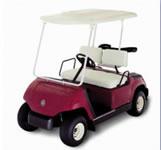
Yamaha Golf Car Company wanted to develop a new golf car canopy to replace their existing thermoformed version. The existing canopy gave a “low quality” impression, and assembly was tedious. Attaching the thermoformed canopy to the golf car involved drilling holes in the canopy to attach three, cumbersome aluminum extrusions (struts).
Yamaha established a set of goals for the new canopy:
- Best in industry in terms of:
- Styling
- Innovative Features
- Safety
- Serviceability
- Customer Satisfaction
- Cost improvements over previous model
- Development time of one year
The Solution
Through the combined efforts of Yamaha, GK Design, Modelex(CAD), Delta Mold and Mack Molding’s Southern Operations, a new canopy was developed: The Ergo Shade™.
The new canopy is molded in a 3000-ton press with 20% calcium filled polypropylene via a single, cold sprue in the center of the part. This material was selected due to its combined flex and impact properties. Four separate gas channels are sequentially fired to help fill the part and form integral features.
The Ergo Shade™ has many innovative features that are industry firsts:
Inboard, molded-in, gas-assist handles for the driver and passenger
Front and rear feet with nesting features that allow parts to be stacked for shipment and storage. Also eliminates disposable packaging required with previous model, an environmental plus.
Fold-up struts (attached at the press by Mack) allow the canopy to ship as a complete assembly, and provide for easy attachment to the golf car by a single person.
The continued collaboration of all parties involved in this program provided Yamaha with a robust design, on budget, and within one year.
The Ergo Shade™ is a trademark of Yamaha Golf Car Company.
For more information about these or other Mack Transportation case studies, contact sales.south@mackmolding.com.
……………………………………………………
Peterbilt HVAC System
Continuing with Mack Transportation case studies – when Peterbilt Motors  Company unveiled its 2006 lineup of Class 8 conventional trucks and tractors, it represented one of the most significant product development investments in its history.
Featuring new technologies and operating environments, the new lineup included an HVAC air distribution system that had been completely redesigned for improved performance. Conceived by Peterbilt’s Senior Project Engineer Wade Walterscheid and Project Engineer Terry Manuel, the patent-pending design teetered between success and failure on one millimeter of tolerance between an injection molded rotating canister and its housing.
Already a current supplier, Mack Molding’s southern operations was chosen to furnish four injection molded parts for the new 2006 Models’ HVAC system – the upper and lower housings, rotating mode cylinder and an air transition part, as well as some 16 additional interior trim components. “Supplier selection is one of the most important management decisions made early on in a program, and this engineering project was the second largest in Peterbilt’s history in terms of capital investment,” says Walterscheid. “Peterbilt considered it paramount that the best possible avenues be taken to guarantee success, and requested that Modine Manufacturing, our system supplier, select Mack for the HVAC injection molding. Mack was able to commit dedicated resources and had the capacity needed to meet our aggressive schedules and production requirements.”
Up for the Challenge
“The overall mode housing design was as simplistic as one can imagine, but caused Mack’s molded components to push the limits of materials and manufacturing processes,” says Walterscheid. Specifically, the challenges included:
- extremely precise clearance (less than 1mm) between the rotating mode cylinder and inside diameter of the assembled scroll housing
- sufficient dimensional stability to deliver very flat parts on a consistent basis that could withstand extreme weather variables
- tooling design that would provide consistent material flow
- narrow timeframe to meet schedule for winter weather testing.
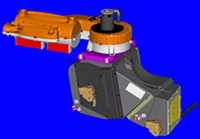 Starting with the material, Mack recommended a custom engineered polycarbonate resin from LNP with a unique blend of glass fiber and glass bead for dimensional stability. “The material had to be able to withstand extreme temperature ranges, from -60 to 120 degrees F, as well as chemical resistance, salt spray, electromagnetic susceptibility and more,” says Ken Kincaid, technical engineering manager at Mack’s southern operations. “Peterbilt subjected the HVAC and other main truck systems to extreme conditions with the vehicle loaded and at road speed in Death Valley, California, in the summer and above the Arctic Circle in the winter. Under both temperature extremes, this material withstood the test.”
Tooling was also critical to maintain dimensional accuracy and consistency. Mack worked with Delta Mold, Charlotte, N.C., to design a family tool that molds both the upper and lower scroll housings in one shot. “Strategically placed gating was crucial to allow for improved material flow to accommodate the tight tolerance requirements,” says Steve Butler, Mack business unit director. “We got first parts off steel tools in 10 weeks to meet Peterbilt’s timeframe for cold weather testing, which was critical to approving the new system for the 2006 lineup.”
Even earlier, Mack Prototype, the company’s prototyping division in Gardner, Mass., molded first parts for airflow and volume testing. Mack Prototype built SLA masters of all four parts, as well as RTV rubber molds for producing polyurethane prototypes.
“The final challenge was presented by the design of the rotating mode cylinder itself, which is extremely complicated for a molded part,” says Kincaid. “Because of its deep ribs and one-piece part design, it had to be rotated 40 degrees and ejected off the tool. That’s a very unorthodox part removal method, but we’ve developed a system to handle it.”
In the end
 Peterbilt’s new design greatly reduced part count, boosted performance and improved climate control. The results have been dramatic:
- 20 percent increase in air flow
- 400 percent improvement in side-window defrost efficiency
- enhanced look and feel with upgraded dash-mounted controls
- more precise temperature management via digital technology
- all-around improvement in assembly ease, reliability and air flow consistency from cab to cab
- overall cost reduction.
For more information about these or other Mack Transportation case studies, contact sales.south@mackmolding.com.